
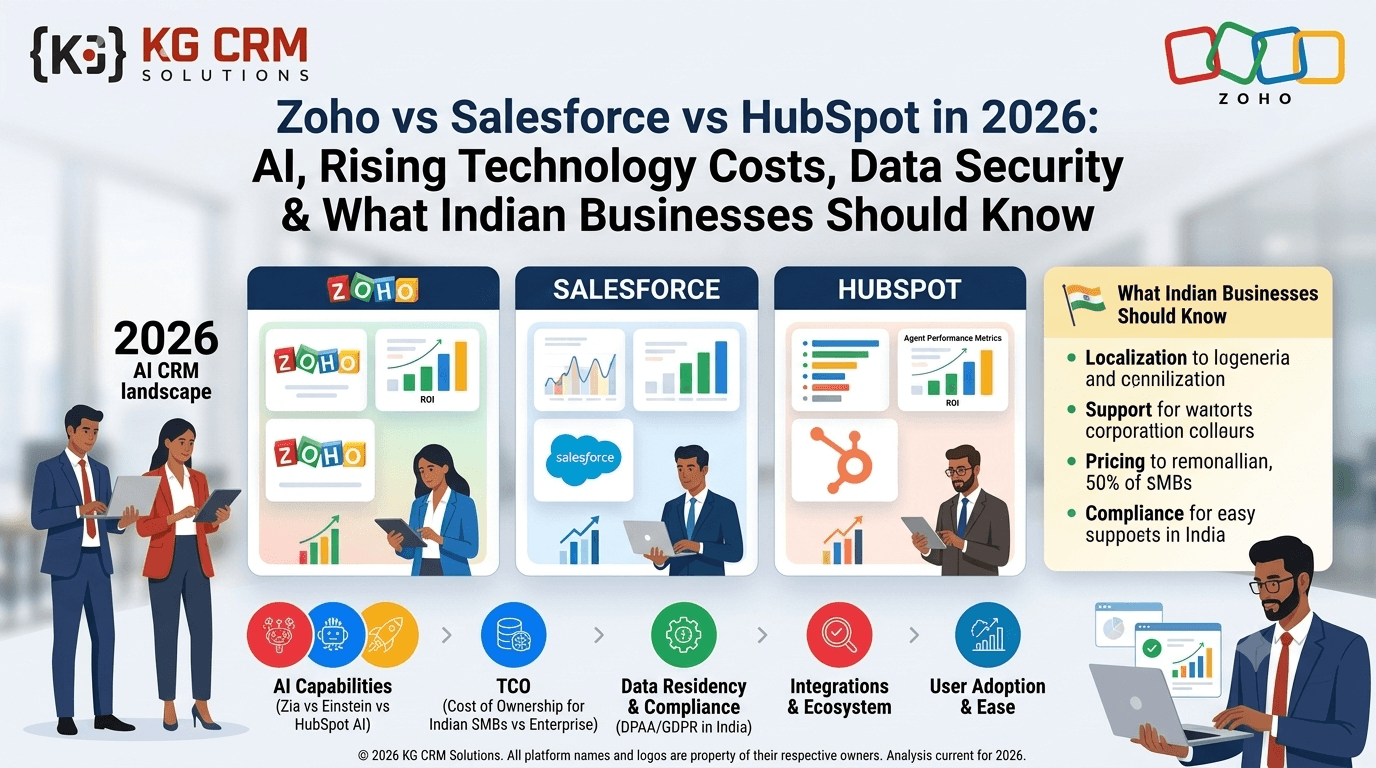
Zoho vs Salesforce vs HubSpot in 2026: AI, Rising Technology Costs, Data Security & What Indian Businesses Should Know
Choosing a CRM in 2026 is no longer just a feature-and-price comparison. Businesses now expect their CRM to deliver AI automation, AI agents, analytics, integrations and strong data security on top of managing leads, contacts and pipelines.
For Indian businesses, three more questions matter: where is our data stored, how does the vendor’s AI handle it, and what will the full system cost over time?
This guide compares Zoho CRM, Salesforce and HubSpot on those points, and explains why the AI boom is starting to matter for the cost of business software.
Zoho vs Salesforce vs HubSpot at a Glance
| Area | Zoho CRM | Salesforce | HubSpot |
| Origin | India | United States | United States |
| AI | Zia, Zia Agents, Zia LLM | Agentforce and Einstein | AI features across its hubs |
| Ecosystem | Very broad Zoho suite (CRM, Books, Desk, Campaigns, Analytics and more) | Large enterprise ecosystem (Slack, Tableau, AppExchange) | Strong sales, marketing, service and content tools |
| Customization | Extensive | Extensive | Good, with platform-specific limits |
| Data hosting for India | India data centre available | India region available through Hyperforce, subject to the services you use | Published hosting locations are the US, EU, Canada and Australia; India is not listed |
| Infrastructure model | Zoho-owned and operated data centres | Public cloud (Hyperforce) | Public cloud (AWS) |
This is not a ranking. The right platform depends on your processes, security requirements, budget and growth plans. Features, regions and pricing vary by edition and contract, so always confirm on each vendor’s official pages.
1. AI Is Now Central to CRM
AI has moved from a nice-to-have to a core part of CRM. Modern platforms use it for:
- Lead qualification and scoring
- Sales forecasting and recommendations
- Customer segmentation
- Email and content generation
- Customer support and natural-language search
- Workflow automation and AI agents
All three vendors are investing heavily. Zoho offers Zia Agents, which can perform tasks inside the CRM, such as acting as a sales development agent. Salesforce has made Agentforce the centre of its product strategy. HubSpot is building AI into its sales, marketing and service tools.
AI is changing not only what CRM software can do, but also how it is built, priced and operated.
2. Why Semiconductor Costs Matter to CRM Buyers
It may seem odd to connect chip prices with CRM software, but AI runs on physical infrastructure: GPUs, CPUs, memory, servers, networking and data centres.
High-bandwidth memory (HBM) is one of the most important components for AI computing. On 29 September 2026, Reuters reported that a Samsung Electronics executive expects HBM to account for nearly 30% of DRAM makers’ total wafer capacity in 2027, up from about 20% today. Because HBM and standard DRAM compete for the same wafer capacity, expanding HBM output could constrain the supply of standard DRAM.
This does not mean CRM subscriptions automatically get more expensive when chip prices rise. The link is indirect. But it shows that the economics of AI infrastructure are becoming a real factor for the whole software industry.
3. From AI Demand to Software Pricing
- More AI adoption: businesses use more AI agents and AI-powered apps.
- More computing demand: AI needs more processing, memory and storage.
- More data-centre investment: cloud and technology companies expand capacity.
- Infrastructure pressure: hardware supply, electricity, cooling and networking become significant costs.
- Software economics: vendors decide how to handle those costs.
Vendors can absorb the costs, improve efficiency, use smaller models for specific tasks, bundle AI into premium plans, or introduce usage-based AI pricing. That is why buyers should look at how a CRM prices its AI, not just the base licence.
4. Salesforce Shows How AI Pricing Is Changing
Salesforce is a useful example:
- It announced an average 6% list-price increase for Enterprise and Unlimited Editions effective 1 August 2025.
- It introduced Flex Credits for Agentforce, a consumption-based model. Salesforce’s published rate is $500 per 100,000 credits, and a standard agent action uses 20 credits (about $0.10).
- Agentforce is also sold through per-user licences and bundled editions, and Salesforce has continued to revise its editions and AI bundles through 2026.
The lesson for buyers: separate the CRM licence cost from the total cost of CRM + AI + usage + data + integrations. Confirm current pricing directly with the vendor before budgeting.
5. Will Every CRM Get More Expensive Because of AI?
Not necessarily. It would be inaccurate to say, “Chip prices rose, so every CRM will raise its price.”
A more accurate statement: the rapid growth of AI is increasing demand for computing infrastructure and semiconductor capacity, creating new cost considerations for technology companies and potentially influencing how AI-enabled software is priced.
6. Zoho’s Different Infrastructure Approach
Zoho owns and operates its own data centres instead of relying on public cloud providers such as AWS, Azure or Google Cloud. Its own Zia LLM is designed to run on Zoho’s servers across its US, India and Europe data centres, so customers can use AI without sending their data to external AI providers.
Two practical points to check: Zia features vary by product, edition and data centre, and if you connect an external model (for example, ChatGPT), data may leave Zoho’s environment. Review the settings and provider terms before enabling it.
7. Data Security in the Age of AI
A CRM holds customer details, deals, contracts, communications and employee information. Once AI is added, you also need to know:
- What data the AI can access
- Which users can use AI, and with what permissions
- Where AI processing takes place
- Whether AI actions are logged and can be audited
This matters most when AI agents take actions rather than just suggest them. Zoho’s Zia Agents, for example, work with roles, profiles and audit visibility for agents deployed as digital employees.
8. India Data Residency: What to Verify
Data location is a key CRM consideration for many Indian organisations. Zoho provides an India data centre, and Salesforce offers an India region through Hyperforce. HubSpot’s published hosting locations are the US, EU, Canada and Australia.
Whichever CRM you choose, ask:
- Where is CRM data stored?
- Where are backups and disaster-recovery copies kept?
- Where does AI processing happen?
- Which products and features are covered by the regional data centre?
- What happens to data when third-party integrations are used?
This is far more useful than simply asking whether a CRM is “secure”.
9. Look Beyond the CRM: Ecosystem Matters
A CRM rarely works alone. Most businesses also need accounting, marketing, support, analytics, email, HR, inventory, project management and custom apps. Zoho offers a broad suite that works with Zoho CRM. Salesforce has a large enterprise ecosystem. HubSpot combines CRM with strong marketing, sales, service and content tools. The best choice depends on your existing technology stack.
10. Total Cost of Ownership Beats Licence Price
Comparing only the subscription is one of the most common CRM mistakes. Real cost includes:
- CRM licences and additional users
- AI features and AI usage
- Storage and API usage
- Integrations and customization
- Implementation, migration and training
- Ongoing support
A CRM with a lower starting price is not always the cheapest over three to five years, and a higher-priced one may reduce other costs. Calculate the complete cost for your own requirements.
11. AI Can Also Reduce Costs
AI is not only a new expense. It can remove repetitive work. A manual lead process (check details, create record, assign, write follow-up, create task, update CRM) can be automated so that the CRM processes the lead, assigns it, drafts the follow-up and creates the task, giving faster response times with fewer manual steps.
So the better question is not “Does this CRM have AI?” but “What measurable business problem will AI solve for us?”
12. AI Agents Are Changing CRM Workflows
Traditional automation follows fixed rules: if lead status = New, send email and assign a salesperson. AI agents can work with more context. They can read CRM data, understand an instruction, choose a tool, take an action, update a record, trigger another workflow and log what they did.
Businesses will increasingly combine business rules + automation + AI agents instead of building dozens of manual workflows.
13. Implementation Still Decides Success
Buying a CRM is only the beginning. It has to be configured around your real process: lead capture, qualification, assignment, follow-up, opportunity management, proposal, closing, onboarding and support. If that foundation is weak, even advanced AI will not produce useful results.
That is why implementation, customization, automation and integration remain essential. For businesses choosing Zoho, an experienced Zoho partner can map existing processes to CRM workflows, integrations and custom apps.
14. Checklist: What to Ask Before Choosing a CRM
- Data: where will customer data be stored?
- Security: how is data encrypted and protected?
- AI access: what information can AI see and act on?
- AI pricing: is AI included, usage-based or a separate charge?
- Infrastructure: what hosting model does the vendor use?
- Integration: does it connect with your existing software?
- Customization: can it adapt to your actual processes?
- Scalability: can it support future growth?
- Implementation: how complex are migration and setup?
- Total cost: what will you really spend over three to five years?
Final Thoughts
Zoho, Salesforce and HubSpot are all capable CRM platforms, but they differ in AI strategy, infrastructure, pricing and ecosystem. Salesforce has moved toward AI-linked pricing such as Flex Credits. Zoho is building Zia Agents and its own Zia LLM on infrastructure it operates itself. Meanwhile, AI demand is putting pressure on chip and memory supply, which makes infrastructure economics part of the CRM conversation.
For Indian businesses, the decision should weigh AI capabilities, data security, data residency, infrastructure, automation, integrations, customization, implementation and total cost of ownership together. The goal is not just to pick a CRM, but to build a system that grows with your customers, processes, data and AI needs.
Planning to Implement Zoho CRM?
KGCRM Solutions helps businesses with Zoho CRM consulting, implementation, customization, automation and integration, built around your actual sales process.
Read Related blogs: Zoho APAC Events 2026
Book a free Zoho CRM consultation: https://www.kgcrmsolutions.com/
KGCRM Solutions
Website: www.kgcrmsolutions.com

About the Author
Parveen Kumar | Founder @ KG CRM Solutions
Parveen Kumar is the founder of KG CRM Solutions, a Zoho Authorised Partner based in Mohali, Punjab. He has been building Zoho systems for businesses across India, the UK, Australia, Canada, and the US for over 8 years, specialising in Zoho CRM, Zoho Creator, Deluge scripting, custom integrations, and widget development.