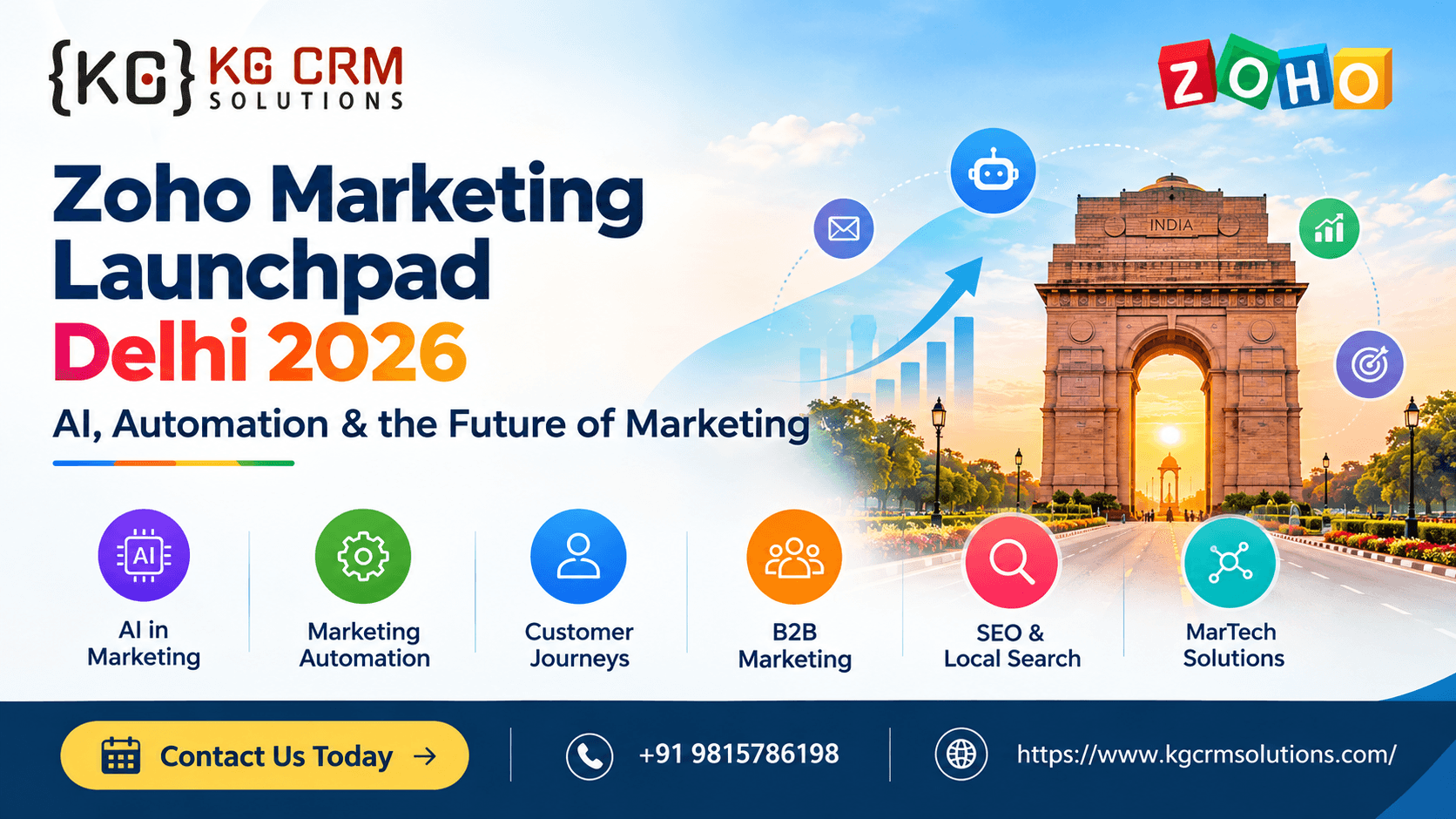
Zoho Marketing Launchpad Delhi 2026: AI, Automation and the Future of Marketing
Marketing is changing quickly. Businesses are no longer relying only on email campaigns, social media posts, or traditional advertising to reach customers. Today, marketing teams are using automation, artificial intelligence, customer data, analytics, and connected business applications to create more relevant and measurable customer experiences.
This is where Zoho Marketing Launchpad becomes relevant for modern marketing teams.
Zoho Marketing Launchpad brings together marketing professionals, business leaders, and technology users to explore practical approaches to modern marketing. Its focus includes areas such as AI, marketing automation, customer journeys, website optimization, social media, B2B marketing, local SEO, customer loyalty, and MarTech.
For businesses in Delhi and the wider NCR region, these topics are particularly relevant as companies look for better ways to generate leads, engage customers, automate repetitive work, and connect marketing with sales.
What Is Zoho Marketing Launchpad?
Zoho Marketing Launchpad is a marketing-focused learning and networking initiative from Zoho.
The program is designed around practical marketing challenges rather than focusing only on individual software features. It looks at how businesses can use technology to improve different stages of the customer journey.
Some of the key areas associated with Marketing Launchpad include:
- Marketing automation
- Artificial intelligence in marketing
- Website optimization
- Social media marketing
- Customer journey management
- B2B marketing
- Local SEO
- Customer loyalty
- MarTech strategy
- Marketing analytics
The broader objective is to help marketers understand how technology, data, and marketing processes can work together.
Zoho Marketing Launchpad Delhi 2026
The Delhi-NCR market includes businesses across technology, professional services, manufacturing, education, real estate, retail, and many other industries. These businesses have different marketing requirements, but many face similar challenges: managing leads, following up with prospects, understanding customer behavior, and measuring marketing performance.
Zoho Marketing Launchpad is relevant to these businesses because it focuses on the practical use of modern marketing technologies.
Businesses interested in the Delhi 2026 edition should check Zoho’s official event announcements for the latest information regarding dates, venue, registration, and availability.
Rather than treating the event as simply another marketing conference, businesses can use the topics covered to review their existing marketing processes and identify areas for improvement.
Why Marketing Automation Matters in 2026
Marketing teams often spend a significant amount of time performing repetitive activities.
Examples include:
- Sending lead follow-up emails
- Assigning leads
- Updating customer information
- Sending campaign notifications
- Segmenting contacts
- Scheduling communication
- Tracking campaign responses
- Creating reports
When these tasks are handled manually, there is a greater chance of delays and inconsistent follow-up.
Marketing automation allows businesses to create predefined workflows that perform repetitive activities based on specific conditions.
For example:
Website enquiry → Lead created → Lead assigned → Follow-up email → Sales notification → Follow-up task
The exact workflow depends on the business, but the basic idea is to reduce unnecessary manual work while keeping customer communication consistent.
Businesses can also connect marketing automation with their CRM processes. This makes it easier for marketing and sales teams to work with the same customer information.
AI Is Changing the Way Marketing Teams Work
Artificial intelligence has become one of the major areas of interest for marketers.
AI can support marketing teams in areas such as:
- Content assistance
- Customer communication
- Data analysis
- Personalization
- Lead qualification
- Customer segmentation
- Chatbots
- Campaign analysis
- Workflow automation
However, AI should not be viewed as a replacement for marketing strategy.
The quality of the result depends heavily on the quality of the data, processes, instructions, and customer information available to the system.
For this reason, businesses should first understand their marketing processes and then identify where AI can provide practical value.
Understanding the Customer Journey
A customer rarely moves directly from discovering a company to making a purchase.
A typical journey may look like:
Search → Website → Content → Enquiry → Follow-up → Sales Conversation → Purchase → Retention
Customers can interact with a business through multiple channels during this journey.
They may:
- Visit the website
- Read a blog
- Submit a form
- Follow a social media page
- Open an email
- Speak with a sales representative
- Request a quotation
- Contact customer support
If this information is stored in disconnected systems, it becomes difficult to understand the complete customer journey.
A connected marketing and CRM process can provide businesses with a clearer view of customer interactions and help teams decide what action should happen next.
B2B Marketing and Lead Nurturing
B2B companies often have longer sales cycles.
A prospect may not be ready to purchase immediately after submitting an enquiry. Instead, they may need additional information, follow-up communication, product demonstrations, pricing discussions, or multiple conversations with the sales team.
This makes lead nurturing an important part of B2B marketing.
A structured nurturing process can include:
- Capturing the lead
- Understanding the lead source
- Segmenting the prospect
- Sending relevant information
- Tracking engagement
- Alerting the sales team when appropriate
- Continuing communication until the prospect is ready
Marketing automation can help manage these activities while CRM provides the sales team with relevant customer information.
Website Optimization and Conversion
Driving traffic to a website is only one part of digital marketing.
Businesses also need to understand what visitors do after reaching the website.
Important questions include:
- Which pages receive the most visits?
- Where do visitors leave?
- Which forms generate enquiries?
- Which content attracts potential customers?
- How many visitors become leads?
- Which traffic sources generate business enquiries?
Website optimization involves using this information to improve the customer experience and increase the likelihood of meaningful actions such as enquiries, registrations, or purchases.
This is particularly important for businesses investing in SEO and paid advertising because increased traffic does not automatically mean increased conversions.
Social Media and Customer Engagement
Social media remains an important part of many businesses’ marketing strategies.
But publishing content regularly is only one part of social media marketing.
Businesses should also consider:
- Audience engagement
- Content performance
- Lead generation
- Customer feedback
- Brand communication
- Campaign measurement
Connecting social media activity with broader marketing and CRM processes can help businesses understand how social interactions contribute to the customer journey.
Local SEO and Customer Reviews
For businesses serving specific cities or regions, local search visibility can be important.
A strong local marketing process may include:
- Optimizing business information
- Creating location-focused content
- Managing customer reviews
- Maintaining consistent business details
- Publishing useful local content
- Monitoring customer feedback
Local SEO should not be treated as a standalone activity. It can be part of a wider process that connects visibility, enquiries, customer communication, and retention.
The Role of CRM in Modern Marketing
Marketing and sales are closely connected.
Marketing generates awareness and leads, while sales works to convert qualified prospects into customers.
A CRM system can help bring these processes together.
For example:
Marketing campaign
↓
Lead generation
↓
CRM lead creation
↓
Lead qualification
↓
Sales follow-up
↓
Opportunity
↓
Customer
This type of connected process gives businesses greater visibility into what happens after a marketing campaign generates a lead.
For businesses looking to improve these processes, Zoho CRM consulting and implementation can help with CRM setup, customization, workflow automation, integrations, and process design.
Connecting Marketing With Business Applications
A modern business may use several applications across its operations.
For example:
- CRM for customer management
- Marketing applications for campaigns
- Analytics for reporting
- Accounting software for financial processes
- Forms for collecting information
- Business applications for internal workflows
The challenge is making these applications work together.
When systems are properly integrated, information can move between applications without requiring employees to repeatedly enter the same data.
This can reduce manual work and improve data consistency.
Why Businesses Should Think About Process Before Automation
Automation is useful, but it should not be the first step.
Before automating a process, businesses should understand:
What is the current process?
Where are delays happening?
Which tasks are repetitive?
What information is required?
Who is responsible for each step?
What should happen when a condition is met?
Once the process is clear, automation becomes easier to plan.
For example, instead of simply saying “automate lead follow-up,” a business can define:
When a new lead arrives from the website, assign it to the appropriate sales representative, send an acknowledgement email, create a follow-up task, and notify the responsible team member.
This creates a much clearer automation requirement.
How KG CRM Solutions Can Help
Businesses attending or following topics from Zoho Marketing Launchpad may identify several areas where their current marketing and customer-management processes can be improved.
This is where KG CRM Solutions LLP can help.
KG CRM Solutions focuses on Zoho solutions and provides services including:
- Zoho CRM Consulting
- Zoho CRM Implementation
- Zoho CRM Customization & Development
- Zoho CRM Automation
- Zoho CRM Integration & Migration
- Zoho Creator Development
- Zoho Analytics
- Zoho One Implementation
Our approach is to understand the business process first and then configure the appropriate Zoho solution around those requirements.
For example, a business may need help connecting lead generation with CRM, automating follow-ups, creating custom CRM modules, integrating applications, or building reports for management.
The goal is to create a system that supports the way the business actually works.
What Businesses Can Take Away From Marketing Launchpad
The most useful takeaway from modern marketing events is not simply learning about new tools.
Businesses should look at how the ideas can be applied to their own processes.
After exploring Marketing Launchpad topics, a company can review:
1. Lead Generation
Where are new leads coming from, and which sources generate meaningful enquiries?
2. Lead Management
Are leads being assigned and followed up consistently?
3. Marketing Automation
Which repetitive marketing activities can be automated?
4. Customer Data
Is customer information available to the right teams when they need it?
5. Marketing and Sales Alignment
Are marketing and sales teams working with the same lead and customer information?
6. Reporting
Can management easily understand campaign and sales performance?
7. Customer Retention
What happens after a prospect becomes a customer?
These questions can help businesses identify practical improvements instead of adopting technology simply because it is new.
Who Can Benefit From Zoho Marketing Launchpad Topics?
The topics covered by Marketing Launchpad can be useful for:
- Business owners
- Marketing managers
- Digital marketing professionals
- Sales managers
- CRM professionals
- Marketing automation specialists
- B2B companies
- Growing businesses
- Technology decision-makers
- Agencies and consultants
It can be particularly useful for organizations that are looking to connect marketing, sales, customer data, and automation into a more organized system.
Preparing Your Business for Modern Marketing
Businesses do not need to automate everything at once.
A practical approach is to start with the areas that create the most manual work or have the biggest impact on customers.
For example:
Step 1: Map the current customer journey.
Step 2: Identify repetitive tasks.
Step 3: Review the existing CRM and marketing tools.
Step 4: Identify disconnected systems.
Step 5: Define automation requirements.
Step 6: Set measurable KPIs.
Step 7: Implement the changes gradually.
Step 8: Review performance and improve the process.
This approach makes marketing technology a business tool rather than simply another software expense.
Final Thoughts
Zoho Marketing Launchpad Delhi 2026 reflects the wider shift toward AI, automation, customer data, connected MarTech, and more structured customer journeys.
For businesses, the important question is not simply which marketing technology to adopt. It is how technology can solve real business problems.
A well-planned combination of marketing automation, CRM, analytics, integrations, and customer data can help businesses create more organized marketing and sales processes.
For companies exploring Zoho CRM implementation, automation, customization, or integration, KG CRM Solutions LLP can help design and implement Zoho-based solutions around specific business requirements.
If your business is looking to improve its CRM and marketing processes, you can contact KG CRM Solutions to discuss your requirements and explore suitable Zoho solutions.
Read Related blogs: zoho-dap-how-businesses

About the Author
Parveen Kumar | Founder @ KG CRM Solutions
Parveen Kumar is the founder of KG CRM Solutions, a Zoho Authorised Partner based in Mohali, Punjab. He has been building Zoho systems for businesses across India, the UK, Australia, Canada, and the US for over 8 years, specialising in Zoho CRM, Zoho Creator, Deluge scripting, custom integrations, and widget development.