
Zoho Inspire India 2026: Insights, Innovation & the Future of Zoho
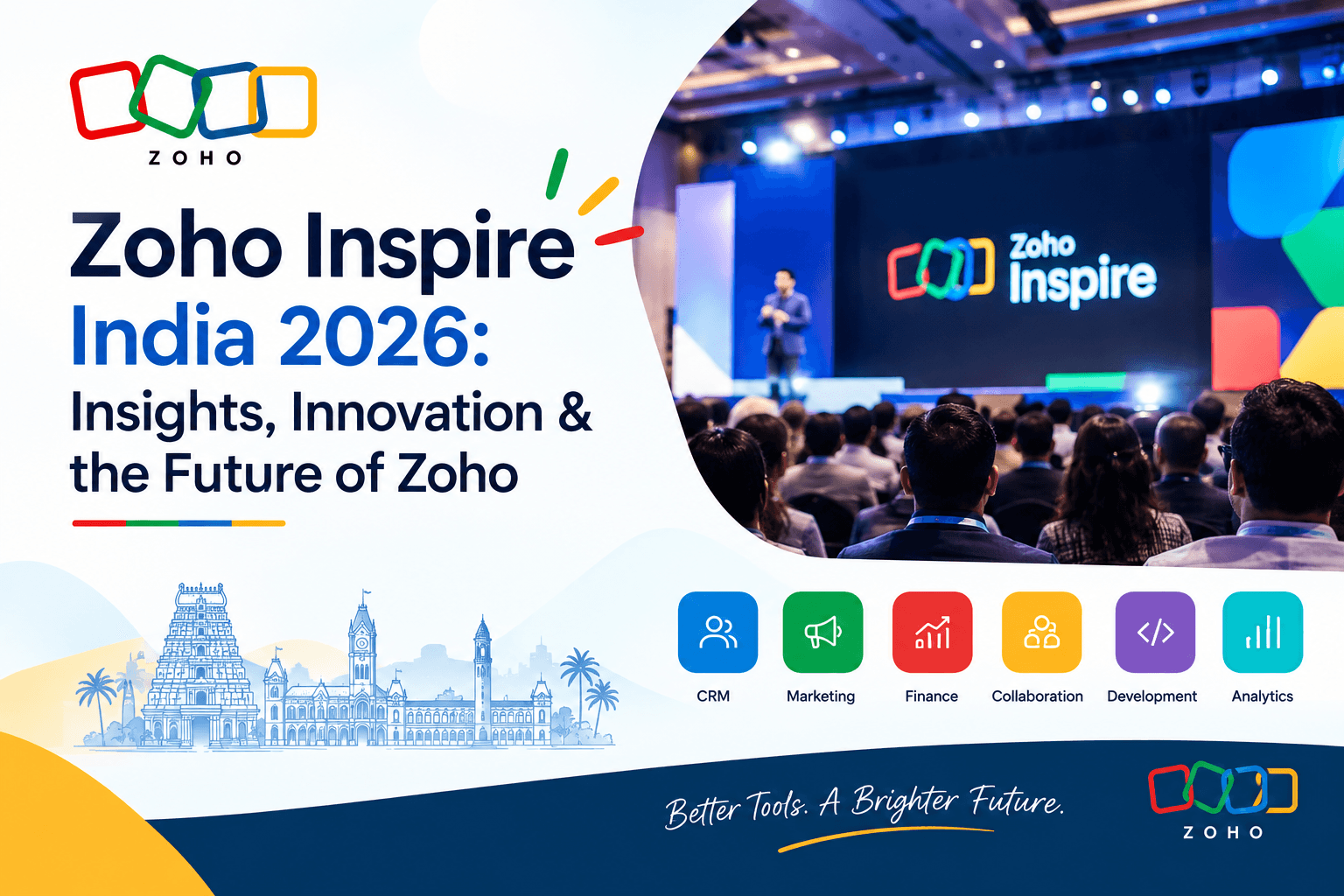
Zoho Inspire is Zoho’s annual partner summit — a gathering built specifically for Zoho partners, product teams, and industry experts to come together around one question: how is the Zoho ecosystem evolving, and what does that mean for the businesses partners serve every day?
Zoho positions Inspire as more than a product showcase. It’s described as a space for partners to learn about upcoming innovations and roadmaps, exchange real implementation experience, and hear success stories from across the partner community. For a company like KG CRM Solutions, which works exclusively within the Zoho ecosystem, that combination of forward-looking product direction and grounded, on-the-ground partner insight is exactly what makes an event like this valuable — it shapes how we approach CRM implementation, customization, integration, automation, and broader process improvement for our clients.
What Is Zoho Inspire?
Zoho Inspire is Zoho’s flagship annual event for its partner network. According to Zoho, the summit is designed to empower partners and create structured opportunities for collaboration — between partners, Zoho’s own product and leadership teams, and industry specialists working across different verticals.
What sets Inspire apart from a standard product launch or webinar is its scope. Rather than focusing narrowly on one application, the conversations at Inspire typically span individual product updates, cross-application integration strategy, evolving customer requirements, and the larger question of how partners guide businesses through digital transformation. It’s less “here’s a new feature” and more “here’s how the pieces fit together, and how you help clients make that work.”
Why Zoho Inspire Matters for Partners
Very few growing businesses run on a single piece of software. A typical company might use a CRM for sales, a separate tool for finance, another for analytics and reporting, and a handful of automation tools stitching processes together behind the scenes.
The real challenge isn’t acquiring these tools — it’s making them work together coherently, without creating data silos or duplicated manual effort. This is precisely where Zoho’s partner ecosystem earns its relevance. Through partner training, certifications, webinars, and its broader consulting partner program, Zoho equips implementation partners to keep pace with a platform that’s constantly expanding.
For partners, that ongoing enablement isn’t optional — it’s a necessity. Customer requirements shift, industries have different compliance and workflow needs, and the Zoho product suite itself grows every year. Staying current is what separates a partner who can configure software from one who can actually solve business problems.
A Closer Look at the Zoho Ecosystem
Over the years, Zoho has built out a genuinely broad business software ecosystem — spanning CRM, finance, marketing, customer support, analytics, collaboration, and low-code application development.
The real opportunity this creates for businesses isn’t just having more tools to choose from — it’s the ability to design connected processes instead of running every department through disconnected systems that don’t talk to each other.
Consider a typical sales journey:
Lead generation → Lead qualification → CRM → Sales follow-up → Customer onboarding → Support → Reporting
Each of these stages can technically be handled by a separate tool. But the real value — fewer manual handoffs, cleaner data, faster response times, better visibility for management — comes from connecting these stages intelligently, not from treating each one as an island.
The Growing Role of AI and Automation
AI and automation are everywhere in business software conversations right now, and Zoho is no exception. But the practical value of either only shows up when they’re applied to real, specific business processes — not when they’re added as a feature checkbox.
For a sales team, meaningful automation might look like automatically assigning incoming leads based on territory or product interest, triggering follow-up reminders when a deal goes quiet, updating records without manual data entry, or generating tasks the moment a deal stage changes. Layer analytics on top of that, and management gets a real-time view of sales activity and performance — not a static monthly report built after the fact.
Zoho’s recent events and communications reflect this shift too. Zoho’s 2026 events page, for instance, puts a spotlight on product insights and “AI at work” as a core theme for its Zoholics India event — a signal of where the platform’s priorities are heading.
For businesses evaluating any of this, the right question isn’t “does this feature use AI?” It’s “where does this actually save time, improve visibility, or make a workflow measurably better?” That distinction matters more than the label.
What Zoho Partners Can Learn From Inspire
One of the most valuable parts of any partner summit is the chance to learn from peers working through the same kinds of challenges — often with different clients, industries, or implementation constraints.
Zoho has said Inspire includes partner success stories and dedicated opportunities to learn from others across the ecosystem. These conversations tend to surface practical, hard-won insight on things like:
- CRM implementation strategy and sequencing
- Business process automation design
- Application integration approaches
- Customer onboarding workflows
- Industry-specific solution patterns
- Zoho product adoption and change management
- Handling complex, multi-department implementation requirements
- Building genuinely connected workflows across applications
For implementation partners, this kind of exchange is where theoretical product knowledge turns into practical, repeatable implementation approaches — the difference between knowing what a feature does and knowing when and how to deploy it for a specific client.
Why Implementation Experience Matters
Selecting the right CRM is only step one. The system also has to reflect how a business actually operates — not how a generic template assumes it operates.
In practice, that often means customizing modules to match real sales terminology, building approval workflows that mirror existing sign-off chains, connecting external applications like accounting or marketing platforms, migrating historical customer data without losing integrity, building reports that decision-makers will actually use, and automating the repetitive tasks that quietly eat up a sales team’s week.
Get this wrong, and customization becomes complexity for its own sake — a system that’s technically powerful but practically confusing. A well-planned implementation starts somewhere else entirely: by understanding the existing process first, and only then identifying where Zoho can genuinely improve it. That sequencing — process before configuration — is where hands-on implementation experience becomes the deciding factor between a CRM that gets adopted and one that gets ignored.
KG CRM Solutions’ Zoho Focus
KG CRM Solutions LLP works exclusively with Zoho — we don’t split our attention across multiple platforms. That focus lets us go deeper into helping businesses implement and continuously improve their Zoho environment.
Our work spans:
- Zoho CRM Implementation
- Zoho CRM Customization & Development
- Zoho CRM Integration & Migration
- Zoho CRM Automation
- Zoho Creator Development
- Zoho Analytics
- Zoho One Implementation
Our approach starts with understanding a client’s actual business process before we decide how the Zoho platform should be configured around it. We don’t treat every implementation the same way — the goal is always to identify the real underlying requirement first, then build the right solution on top of it, rather than starting from a template and forcing the business to adapt to it.
From Product Features to Business Results
One of the most important lessons for any business adopting CRM software: more features do not automatically translate into better outcomes.
A CRM’s job is to make everyday work easier — full stop. For a sales team, that might mean a genuinely clear view of leads and open opportunities, without digging through noise. For management, it might mean dashboards and reports they can actually trust and act on. For operations, it might mean fewer manual tasks and tighter coordination between teams that used to work in silos.
The implementation is what bridges the gap between “powerful software” and “software that actually improves how the business runs.” Without that bridge, even the most feature-rich CRM ends up underused.
What Businesses Should Consider Before Starting a Zoho Project
If you’re evaluating Zoho CRM — or planning to expand an existing setup — it’s worth answering these questions before writing a single configuration:
- What process are we trying to improve?
Start with the business problem, not the software feature. Features are a means, not the goal. - What information needs to be managed?
Map out customers, leads, deals, products, activities, documents, and any other data that matters to daily operations. - Which systems need to be connected?
List every accounting platform, website, email tool, marketing system, payment gateway, or other application that needs to talk to the CRM. - What should be automated?
Identify the repetitive activities quietly consuming employee time or creating unnecessary manual work — these are usually the highest-ROI automation targets. - What reports does management actually need?
Define the decisions that need to be supported by CRM data before building a single dashboard. Reports built without a decision behind them rarely get used. - What happens after implementation?
Training, ongoing support, monitoring, iterative improvements, and future customization all need a plan — a CRM project doesn’t end at go-live.
Looking Ahead With Zoho
Zoho’s partner ecosystem keeps evolving as businesses push for more connected applications, deeper automation, sharper analytics, and increasingly AI-assisted workflows. Zoho’s own partner program continues to emphasize training, certifications, webinars, knowledge sharing, and collaboration as the backbone of how it supports its partner network.
For partners, events like Inspire are a chance to stay plugged into that direction and learn directly from the wider Zoho community. For businesses, though, the real takeaway is more practical: the success of a Zoho implementation depends just as much on how well the technology is matched to a company’s actual processes and goals as it does on the software itself.
Conclusion
Zoho Inspire India 2026 represents an opportunity for the Zoho partner community to connect, exchange real implementation experience, and stay aligned with where the Zoho ecosystem is headed.
For KG CRM Solutions, staying closely engaged with that ecosystem supports what we’re ultimately here to do: help businesses get more value out of their Zoho investment through thoughtful implementation, customization, integration, automation, and ongoing improvement.
If your business is planning a Zoho CRM implementation, customization, integration, or automation project, KG CRM Solutions can help you evaluate your requirements and build a Zoho solution designed around how your business actually works.

About the Author
Parveen Kumar | Founder @ KG CRM Solutions
Parveen Kumar is the founder of KG CRM Solutions, a Zoho Authorised Partner based in Mohali, Punjab. He has been building Zoho systems for businesses across India, the UK, Australia, Canada, and the US for over 8 years, specialising in Zoho CRM, Zoho Creator, Deluge scripting, custom integrations, and widget development.