Zoho CRM Zia Agents: How AI Agents Can Automate CRM Workflows
CRM automation has traditionally been based on predefined rules. A business creates a workflow, sets a trigger, defines conditions, and specifies what should happen next.
That approach is still useful, but AI is changing how businesses think about CRM automation.
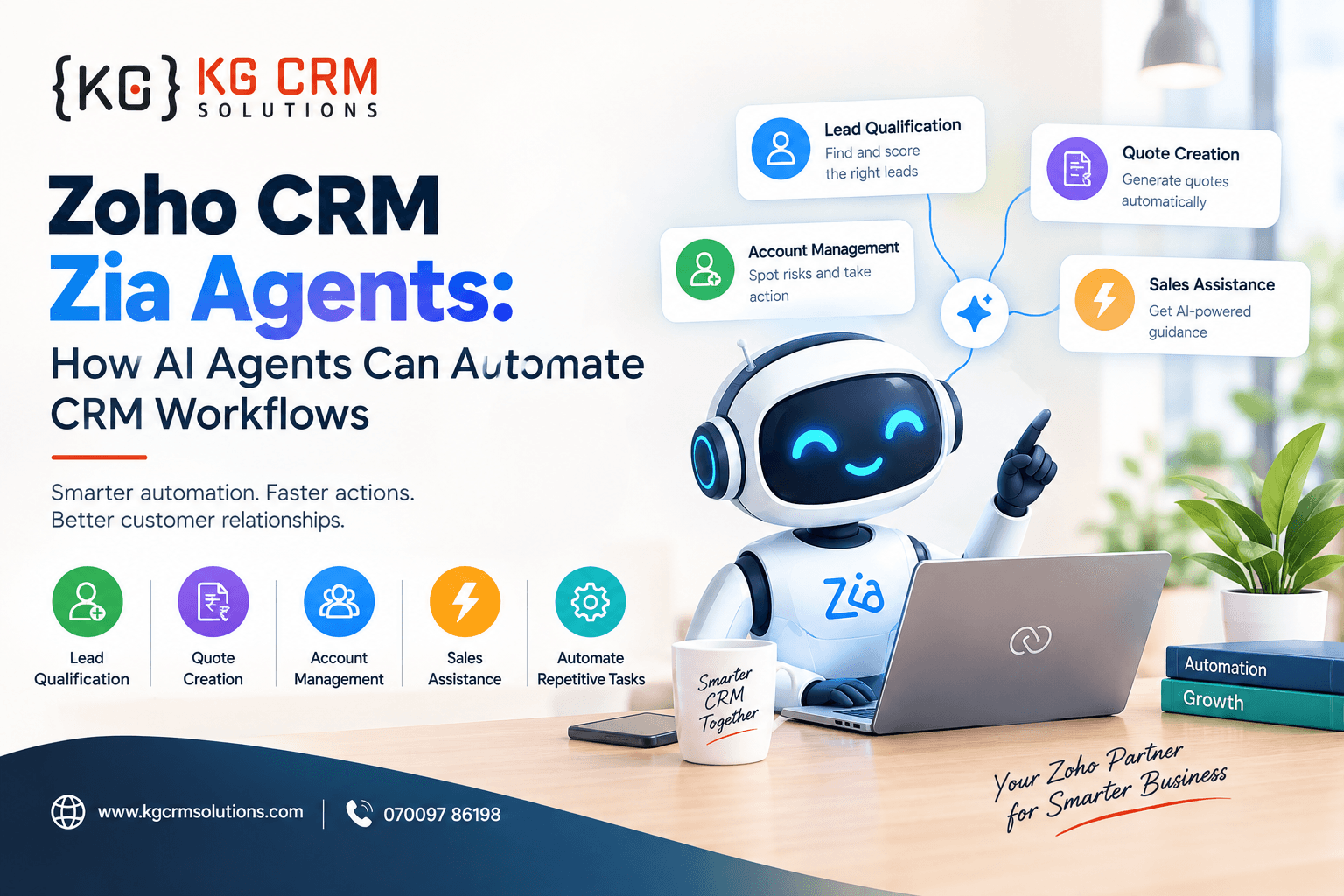
With Zoho CRM Zia Agents, businesses can introduce AI agents that can perform specific tasks, work with CRM data, and take actions based on defined business requirements. Instead of simply providing information or generating content, these agents can be configured to perform tasks inside Zoho CRM.
This creates new possibilities for sales teams, account managers, and CRM administrators looking to reduce repetitive work and make their processes more responsive.
What Are Zoho CRM Zia Agents?
Zoho CRM Zia Agents are AI-powered agents that can be created or deployed to perform specific tasks within Zoho CRM.
Unlike a traditional chatbot that mainly responds to questions, an AI agent can be designed to perform actions based on its instructions, available tools, CRM data, and permissions.
Zoho’s current documentation gives examples including:
- Lead qualification
- Sales guidance
- Quote creation
- Account management
- Identifying potentially at-risk accounts
- Triggering actions based on CRM conditions
Businesses can create agents based on their requirements or use pre-built agents available through the Zia Agents environment.
How Do Zia Agents Work in Zoho CRM?
The basic process involves creating or selecting an AI agent, defining what the agent should do, connecting the required tools and information, testing it, and then deploying it into Zoho CRM.
For example, a company could create a Quote Creation Agent that uses information from a deal to prepare a quote using predefined fields and formats.
Another example could be an Account Manager Agent that identifies accounts showing signs of reduced engagement and recommends or triggers appropriate follow-up actions.
The agent operates according to the permissions and configuration provided to it, which is important when working with business and customer data.
Zoho CRM Zia Agents vs Traditional CRM Automation
Traditional CRM automation generally follows a fixed structure:
Trigger → Condition → Action
For example:
When a new lead is created → check the lead source → assign it to a sales representative.
This works well when the business process is predictable.
AI agents provide another approach.
An agent can be configured with a specific objective, instructions, tools, and access to relevant information. It can then perform tasks within the boundaries defined for it.
| Traditional Workflow | Zia Agent |
| Follows predefined rules | Works according to instructions and available context |
| Usually trigger-based | Can support different interaction and trigger methods |
| Performs predefined actions | Can perform configured tasks |
| Best for predictable processes | Useful for more context-dependent tasks |
| Requires workflow configuration | Requires agent setup, instructions, tools and permissions |
This does not mean that AI agents replace workflows. In many CRM environments, traditional automation and AI agents can work together.
How Can Zia Agents Automate CRM Workflows?
1. Lead Qualification
Lead qualification is one of the areas where AI agents can reduce repetitive sales work.
An agent can be designed to evaluate available lead information according to defined criteria and assist with qualification.
For example, a business may want to consider:
- Industry
- Company size
- Lead source
- Location
- Previous interactions
- Business requirements
The agent can use the available information to support the qualification process and help sales teams focus on relevant leads.
2. Quote Creation
Preparing quotes can involve repeatedly collecting information from CRM records and entering it into a predefined format.
Zoho’s documentation specifically describes a Quote Creation Agent that can generate quotes using deal information and mapped fields.
This can reduce manual data entry and help sales representatives move from an opportunity to a quotation more efficiently.
3. Account Management
AI agents can also support customer and account-management activities.
For example, an account-management agent can identify signals such as reduced deal activity, delayed renewals, or support escalations and help identify accounts that may require attention.
The goal is not simply to display another report. The agent can be configured to assist with the next step based on the business process.
4. Sales Assistance
Sales representatives often need information while working with leads and opportunities.
A Zia Agent can be configured to provide context-specific assistance based on the business requirements and information available to it.
This can help sales teams spend less time searching through CRM records and more time working with customers.
5. Repetitive CRM Tasks
Businesses often have small CRM tasks that consume time when performed manually.
Depending on the agent’s configuration, AI can help with activities such as:
- Processing CRM information
- Preparing sales documents
- Supporting lead qualification
- Identifying accounts requiring attention
- Providing sales guidance
- Performing configured CRM actions
The exact capabilities depend on how the agent is built, deployed, and what permissions and tools are provided.
Why AI Agents Are Different From Simple AI Assistants
There is an important difference between AI assistance and AI agents.
A traditional AI assistant might answer:
“What is the current value of this opportunity?”
An AI agent can potentially go further by performing a configured task related to that opportunity.
For example:
“Create a quote using the information available in this deal.”
The difference is the ability to move from information → action.
That is one reason AI agents are becoming an important part of modern CRM automation.
Can Zia Agents Replace Zoho CRM Workflows?
Not necessarily.
Traditional workflows remain valuable for processes that are simple, predictable, and rule-based.
For example:
New lead created → Assign to sales team
There may be no need for an AI agent for this type of straightforward automation.
AI agents can become more useful when a process requires additional context or multiple steps.
A practical Zoho CRM setup could therefore use:
Workflows + Functions + Blueprints + AI Agents + Integrations
Each automation method can serve a different purpose.
What Businesses Should Consider Before Using Zia Agents
AI automation should start with the business process, not the technology.
Before deploying an agent, businesses should identify:
Business objective
What specific problem should the agent solve?
Data
What CRM information does the agent need?
Permissions
What records and actions should the agent be allowed to access?
Tools and connections
Does the agent need access to other applications or services?
Human involvement
Which actions should require human review?
Monitoring
How will the business check whether the agent is performing as expected?
These considerations are especially important when an AI agent can perform actions rather than simply provide information.
Zia Agents and CRM Security
CRM systems contain sensitive customer and business information, so AI automation should be implemented with appropriate access controls.
Zoho’s deployment options include using a connection or deploying an agent as a Digital Employee. With the Digital Employee approach, the agent can have its own role, profile, and identity, while actions can be logged under that agent’s identity.
This type of control can help organizations maintain visibility into what an AI agent is allowed to access and what actions it performs.
Where Zoho CRM Implementation Still Matters
AI agents can simplify certain CRM tasks, but businesses still need a well-designed CRM structure.
Before introducing AI automation, organizations should understand:
- Sales processes
- Lead-management rules
- CRM data structure
- User roles
- Permissions
- Approval processes
- Existing workflows
- Third-party integrations
- Reporting requirements
If the underlying CRM setup is poorly structured, adding AI agents does not automatically solve the problem.
A properly implemented CRM provides a stronger foundation for automation and AI.
How KG CRM Solutions Can Help With Zoho CRM Automation
KG CRM Solutions LLP focuses exclusively on Zoho solutions, helping businesses build and improve their Zoho environment.
Our services include:
- Zoho CRM Implementation
- Zoho CRM Consulting
- Zoho CRM Customization & Development
- Zoho CRM Automation
- Zoho CRM Integration & Migration
- Zoho Creator Development
- Zoho Analytics
- Zoho One Implementation
For businesses exploring Zoho CRM Zia Agents, the first step is to identify which CRM processes are repetitive, rule-based, or require more intelligent decision support.
KG CRM Solutions can help businesses evaluate their existing CRM processes and determine where Zoho CRM automation, customization, integrations, and AI-powered capabilities can fit into the overall system.
Learn more about our Zoho services at https://www.kgcrmsolutions.com/.
The Future of Zoho CRM Automation
The role of AI in CRM is moving beyond recommendations and generated content.
Modern CRM platforms are increasingly focusing on AI that can work with business data, understand context, and perform tasks.
Zoho’s broader AI strategy is also moving toward conversational interfaces and industry-specific AI capabilities. Recent Zoho developments include Zia Chat and industry-specific AI agents, showing how the company is expanding AI beyond individual CRM features.
For businesses, this means CRM automation may increasingly involve a combination of:
Rules + Automation + Integrations + AI Agents
The important question will not simply be whether a business can use AI. It will be where AI can genuinely improve an existing business process.
Frequently Asked Questions
What are Zoho CRM Zia Agents?
Zoho CRM Zia Agents are AI-powered agents that can be configured and deployed to perform specific tasks within Zoho CRM based on defined instructions, tools, data, and permissions.
What can Zia Agents do in Zoho CRM?
Depending on their configuration, Zia Agents can support tasks such as lead qualification, quote creation, sales assistance, and account-management activities.
Are Zia Agents the same as Zoho CRM workflows?
No. Workflows generally execute predefined rules and actions, while AI agents can be configured to perform more context-dependent tasks. Businesses can use both approaches together.
Do businesses still need CRM automation after using AI agents?
Yes. Standard workflows remain useful for predictable and rule-based processes. AI agents can complement traditional automation where additional context or more complex tasks are involved.
Can KG CRM Solutions help with Zoho CRM automation?
Yes. KG CRM Solutions LLP provides Zoho CRM implementation, customization, automation, integration, and other Zoho-related services for businesses.
Final Thoughts
Zoho CRM Zia Agents represent a shift from traditional rule-based automation toward more intelligent, task-oriented CRM automation.
Instead of using AI only to generate information or recommendations, businesses can configure agents to perform specific CRM tasks such as qualifying leads, creating quotes, supporting account management, and assisting sales teams.
However, successful AI automation still depends on good CRM data, clear business processes, appropriate permissions, and thoughtful implementation.
For businesses already using Zoho CRM, Zia Agents can become another component of a broader automation strategy—working alongside workflows, custom functions, integrations, and other Zoho capabilities.
Read Related blogs : https://www.kgcrmsolutions.com/blog/zoho-crm-native-agents

About the Author
Parveen Kumar | Founder @ KG CRM Solutions
Parveen Kumar is the founder of KG CRM Solutions, a Zoho Authorised Partner based in Mohali, Punjab. He has been building Zoho systems for businesses across India, the UK, Australia, Canada, and the US for over 8 years, specialising in Zoho CRM, Zoho Creator, Deluge scripting, custom integrations, and widget development.