

Zoho vs AWS, Google Cloud, and Microsoft Azure: What Is the Real Difference for Businesses?
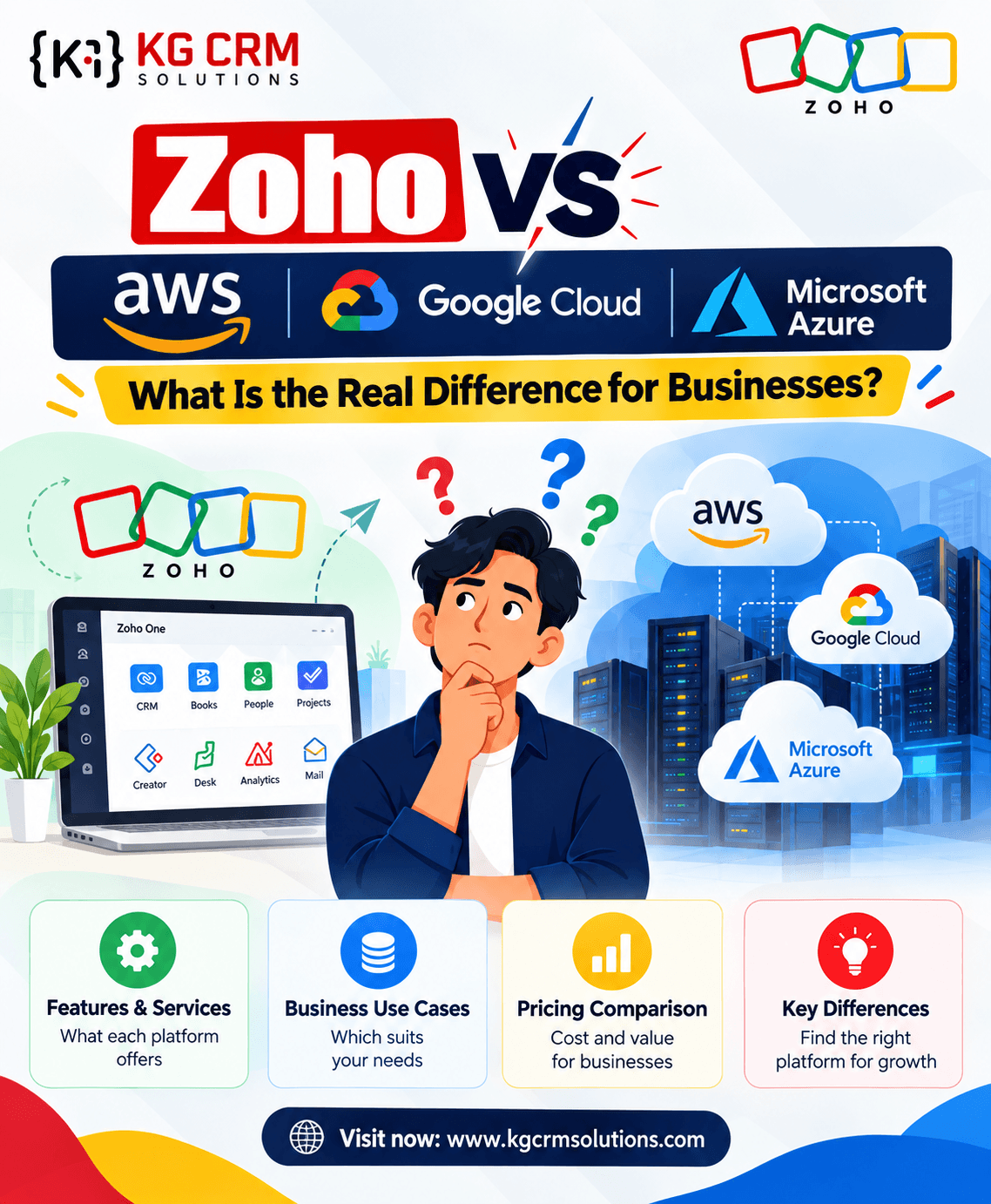
One of the biggest differences between Zoho and many other software companies is how they manage the infrastructure behind their products.
Many software providers build their applications on infrastructure rented from major cloud providers. Zoho, by contrast, has invested in owning and operating its own infrastructure. This difference can influence how the company manages costs, protects data, develops products, and plans its technology roadmap.
However, Zoho and AWS, Azure, and Google Cloud do not offer exactly the same type of service. Zoho primarily provides ready-to-use business applications, while the major public cloud platforms also provide infrastructure that developers can use to build and host their own applications.
Why Zoho Built Its Own Cloud Infrastructure: What It Means for Businesses
1. Zoho Has More Direct Control Over Its Infrastructure
When a software company depends heavily on an external cloud provider, its infrastructure operations can be affected by that provider’s pricing, service options, and technical decisions.
Zoho’s own infrastructure gives it more direct control over the hardware, network, and systems supporting its applications.
How this benefits businesses: Zoho can make infrastructure decisions around the requirements of its own products. This can help the company coordinate product development, infrastructure management, and long-term investment without relying entirely on another cloud provider.
It does not mean AWS, Azure, or Google Cloud are unreliable. These companies provide extensive infrastructure services, and many businesses benefit from their scale and flexibility. The difference is the degree of direct infrastructure control.
2. How Zoho’s Infrastructure Strategy Can Affect Costs
Operating data centers requires substantial investment in servers, networking, electricity, cooling, maintenance, and engineering. Zoho takes on these responsibilities by investing in its own infrastructure.
This model may give Zoho more control over long-term infrastructure costs and reduce its dependence on pricing changes from an external cloud provider.
For customers, that can support more predictable product planning and give Zoho greater flexibility in deciding how to price and develop its services.
There is an important distinction, however: owning infrastructure does not guarantee that Zoho will always be cheaper than competitors. Subscription prices also depend on product development, staffing, support, licensing, and other operating expenses.
For businesses choosing Zoho CRM or Zoho One, the better comparison is the total cost of the solution, including subscriptions, implementation, customization, integrations, and ongoing maintenance.
3. What Zoho’s Infrastructure Means for Data Privacy
Data privacy is another important consideration.
With Zoho’s infrastructure model, the company directly manages key parts of the environment in which its applications and customer data operate. Zoho also publishes information about its data centers, encryption, and security controls.
This approach can help businesses evaluate how their data is hosted and protected.
For example, a company using Zoho CRM may store customer contacts, sales records, deal information, and communications in the platform. A business using Zoho Books may manage invoices and financial records.
In both cases, organizations should check the applicable data center region, access controls, security features, and contractual requirements before moving sensitive business information into the system.
The practical benefit is greater clarity and direct provider control over the infrastructure—not an automatic guarantee that data is risk-free.
4. Zoho’s Approach to Data Residency
Businesses operating in India and other regulated markets may need to understand where their data is stored.
Zoho maintains data centers in multiple regions and associates accounts with the relevant data center. This can help businesses assess their data residency requirements.
AWS, Microsoft Azure, and Google Cloud also offer regional infrastructure, including regions in India. Therefore, Zoho’s difference is not simply that it can store data locally; it is that Zoho manages its own infrastructure while also providing the business applications.
For companies with regulatory obligations, the correct decision depends on the specific application, applicable data-processing terms, and relevant legal requirements.
5. How This Differs From Traditional Cloud Storage Providers
Cloud storage services such as Amazon S3, Azure Blob Storage, and Google Cloud Storage allow organizations to store files, backups, documents, and application data. These services are building blocks that developers and IT teams can use in their own systems.
Zoho’s approach is different because it operates the infrastructure supporting its business applications, including tools for CRM, accounting, analytics, and collaboration.
| Business consideration | Zoho’s infrastructure model | Public cloud infrastructure |
| Main purpose | Deliver integrated business applications | Provide infrastructure and services for many types of workloads |
| Infrastructure control | Zoho operates its own infrastructure | The cloud provider operates the infrastructure; customers manage resources according to their service model |
| Data storage | Data is handled within the applicable Zoho service and region | Customers select and configure storage services and regions |
| Pricing considerations | Business application subscriptions and related service costs | Infrastructure usage, storage, data transfer, support, and other applicable charges |
| Technical flexibility | Applications are designed around Zoho’s ecosystem | Broad flexibility to build and operate custom applications |
| Best suited for | Businesses seeking ready-to-use business applications | Organizations needing infrastructure to build, host, or customize their own systems |
Neither model is universally better. A business that wants a managed CRM, accounting system, and workflow automation platform may prefer Zoho. A company developing a custom application or managing large-scale infrastructure may need AWS, Azure, Google Cloud, or another infrastructure provider.
6. Can Zoho’s Infrastructure Help Reduce Dependence on Big Tech?
Yes, in a specific sense.
Because Zoho operates its own infrastructure, its business applications are not entirely dependent on the infrastructure services of AWS, Azure, or Google Cloud.
This gives Zoho more independence over key technology decisions, infrastructure investment, and product development.
For customers, this can provide another option in a market where many digital services rely on a relatively small number of major cloud infrastructure providers.
However, choosing Zoho does not eliminate every form of technology dependence. Businesses still need to consider their reliance on Zoho’s applications, data formats, APIs, integrations, and export options. They should maintain appropriate data-management and continuity plans.
What Does This Mean for Businesses Choosing Zoho?
The main advantage is not simply that Zoho owns servers. It is how that infrastructure strategy supports the business applications customers use every day.
Businesses can use Zoho CRM to manage sales, Zoho Books to manage accounting, Zoho Analytics to create reports, and Zoho Creator to build custom applications.
When these tools are configured and integrated properly, companies can reduce manual work, improve information sharing, and create more consistent business processes.
For decision-makers, Zoho’s infrastructure ownership is one factor worth considering alongside application features, pricing, security, support, integrations, and regulatory requirements.
The right choice should be based on the business outcome you need—not just the technology running behind the software.
Final Thoughts
Zoho’s decision to invest in its own cloud infrastructure is an important part of its broader approach to building and operating business software. It gives the company direct control over key infrastructure components and supports its focus on privacy, scalability, and integrated product development.
For businesses, the most important consideration is how these capabilities fit their own requirements. Data residency, security controls, application functionality, integrations, and implementation quality all matter when selecting a business software platform.
With the right planning and configuration, Zoho applications can help organizations streamline customer management, automate repetitive tasks, and connect important business processes.
Looking to implement or improve your Zoho setup? Contact KG CRM Solutions LLP to explore practical Zoho CRM, integration, automation, and application development solutions for your business.
Related Articles : Zoho APAC Events 2026

About the Author
Parveen Kumar | Founder @ KG CRM Solutions
Parveen Kumar is the founder of KG CRM Solutions, a Zoho Authorised Partner based in Mohali, Punjab. He has been building Zoho systems for businesses across India, the UK, Australia, Canada, and the US for over 8 years, specialising in Zoho CRM, Zoho Creator, Deluge scripting, custom integrations, and widget development.